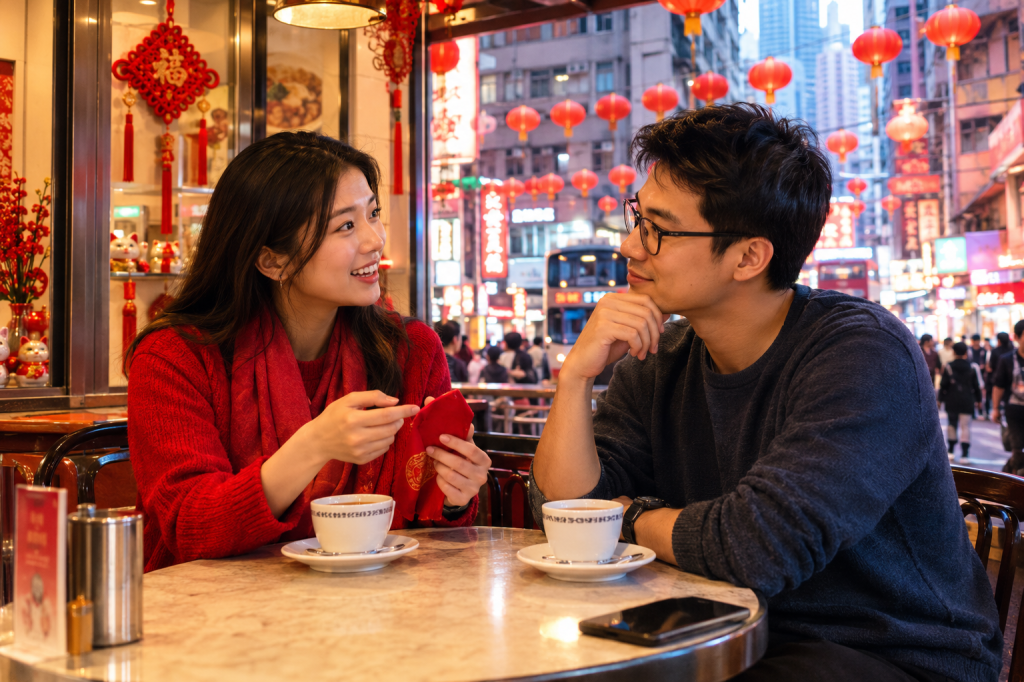
Mei: Daniel! Tell me you bought something red to wear for Lunar New Year.
Daniel: Does a red packet count?
Mei: Very funny. I’m serious! You need to wear red. Red attracts good fortune, drives away evil spirits, and brings prosperity. It’s practically compulsory.
Daniel: Practically compulsory? I didn’t realise the universe had a dress code.
Mei: Laugh all you want. My grandmother always wore red on the first day of Lunar New Year. She lived to ninety-six, had a happy family, and never ran out of money.
Daniel: That’s lovely. But how do you know the red clothes caused any of that?
Mei: Because she wore red and had good luck!
Daniel: And people who wore blue and lived to ninety-six? What about people who wore red and lost their fortunes?
Mei: You’re ruining a perfectly good tradition with your questions.
Daniel: I’m not trying to ruin it. I’m just separating what makes us feel good from what actually changes our luck.
Mei: Fine, Professor Daniel. Let me explain something. In Chinese culture, red symbolises happiness, vitality, prosperity, and good fortune. That’s why we use red decorations, red envelopes, and red wedding outfits. Surely there’s a reason this tradition has survived for centuries.
Daniel: Absolutely. Red has deep cultural meaning. During Lunar New Year, the decorations create excitement and a sense of belonging. At weddings, red symbolises a joyful beginning. And giving lai see makes people feel connected.
Mei: Exactly! So you admit red brings good things.
Daniel: I admit red brings people together. That’s not quite the same as saying it magically attracts wealth.
Mei: You think everything needs a scientific paper before you can enjoy it.
Daniel: Not everything. I eat pineapple buns without demanding a clinical trial. But if you claim a colour changes your financial future, that’s a different claim.
Mei: Let me tell you a story. Last year, I wore a red dress to a job interview. I got the job! The interviewer even said I looked confident.
Daniel: That actually makes sense.
Mei: See? Finally!
Daniel: The dress may have helped you feel confident. Red is visually striking, and clothing can affect how we feel and how others perceive us. Confidence can influence an interview. But that doesn’t mean red attracted supernatural luck.
Mei: So you’re saying my dress helped me get the job?
Daniel: Possibly, indirectly. Your qualifications, answers, preparation, and the interviewer’s judgement probably mattered much more. If you had worn a red dress but arrived twenty minutes late and couldn’t answer a single question, would the colour have rescued you?
Mei: No. But I would have looked fabulous while being unemployed.
Daniel: At least your failure would have been festive.
Mei: You’re impossible.
The waiter brings their milk tea. Mei notices a red paper decoration hanging above the counter.
Mei: Look around. Every shop is covered in red. Businesses know something you don’t. Red attracts customers and prosperity.
Daniel: Businesses also know customers expect red during Lunar New Year. If every bakery in Mong Kok decorates with red lanterns, a bakery that decorates with gloomy grey skulls might struggle.
Mei: I would definitely avoid that bakery.
Daniel: There you go. Red can influence behaviour through culture, familiarity, and emotion. That’s a real effect. But the colour itself doesn’t guarantee business success.
Mei: My uncle put a red sticker on his shop door every New Year. His business grew for twenty years.
Daniel: Did he also improve his products, build relationships with customers, and keep his prices competitive?
Mei: Yes, obviously.
Daniel: Then perhaps those things deserve some credit, too.
Mei: You’re giving the sticker absolutely no credit!
Daniel: I’ll give it credit for being cheap, decorative, and probably excellent for family arguments.
Mei: You know, if I had your attitude, I’d be terrified of everything. No lucky colours, no auspicious dates, no feng shui. How do you make important decisions?
Daniel: By looking at the risks, the available evidence, and what I can control. If I’m buying an apartment, I check the finances, location, building condition, and legal documents. I don’t assume a red shirt will protect me from a bad mortgage.
Mei: My aunt chose an auspicious date for her wedding. She’s been happily married for thirty years.
Daniel: I’m glad she’s happy. But plenty of couples marry on auspicious dates and later divorce. Plenty marry on ordinary dates and stay together for life. To establish that a date predicts marital success, we’d need reliable comparisons between couples, not just a few memorable stories.
Mei: So, according to you, my aunt’s wedding date was meaningless?
Daniel: Not emotionally meaningless. It might have made the day feel special to her family. That’s valuable in its own right. I just wouldn’t confuse symbolic meaning with predictive power.
Mei: Hmm. I suppose there is a difference between something being meaningful and something being scientifically proven.
Daniel: Exactly. And you don’t have to abandon one to accept the other.
Mei: But there’s another thing. My mother says wearing red protects you from bad luck. I always wear red underwear on important days. Exams, interviews, business meetings. Everything.
Daniel: Everything?
Mei: I once wore red underwear to a beach holiday because I was worried about bad weather.
Daniel: Mei, if red underwear could control the Hong Kong weather, the Observatory would be out of business.
Mei: Don’t mock the underwear. It has an excellent track record.
Daniel: How many times did you wear it and still have a bad day?
Mei: I don’t keep records of bad luck.
Daniel: That’s precisely the problem. If something good happens, you remember the red underwear. If something bad happens, you might blame the weather, the timing, or something else. That’s confirmation bias: we notice the examples that support what we already believe and overlook the ones that don’t.
Mei: So my brain is cheating me?
Daniel: Not deliberately. Human brains are brilliant at finding patterns, even when the patterns are accidental. If you flip a coin and get five heads, you might think something unusual is happening. But random events can form streaks without any hidden force.
Mei: And if I wear red and win the Mark Six lottery?
Daniel: I’ll personally buy you a red wardrobe.
Mei: Promise?
Daniel: On one condition: we also count every red-clad person who buys a ticket and doesn’t win.
Mei: That sounds like a terrible research project. You’d need thousands of people.
Daniel: Probably. You’d want a suitable comparison group, clear outcome measures, and enough data to distinguish a genuine effect from chance. Otherwise, one lucky winner proves very little.
Mei: But if wearing red makes me feel more positive, isn’t that enough? Perhaps I perform better because I believe I’ll have good luck.
Daniel: That’s a much stronger argument. Expectations can sometimes affect confidence, attention, and behaviour. A ritual might help you feel calmer before a difficult event. But the benefit would come from the psychological effect, not evidence that red controls external events.
Mei: So my lucky underwear is basically a confidence coach.
Daniel: A very poorly dressed confidence coach.
Mei: And you wonder why I don’t invite you to family dinners.
They both laugh. Mei takes a sip of milk tea and looks through the window at the red lanterns hanging across the street.
Mei: You know, I think you’re missing something. My grandmother used to give me a red packet every Lunar New Year. She would tell me to study hard, be kind, and remember my family. When I see red now, I think of her.
Daniel: That’s different. The colour reminds you of someone you love. There’s nothing irrational about that.
Mei: It makes me feel protected, even though she’s gone.
Daniel: And that feeling is real. The protection might be emotional rather than supernatural, but emotional comfort matters. Science doesn’t require us to stop caring about symbols.
Mei: Then why are you so determined to argue with me about red?
Daniel: Because you sometimes treat a tradition as a guarantee. Suppose someone believes a red charm will protect them from an accident and stops wearing a seat belt. That’s dangerous. Or someone spends money they can’t afford because they believe a lucky colour will bring wealth. That’s where a harmless belief can become harmful.
Mei: Fair point. I wouldn’t tell anyone to skip a seat belt.
Daniel: Good. Wear red, decorate your home, give lai see, celebrate with your family. Just don’t let a lucky colour replace sensible decisions.
Mei: And you could try being a little less dismissive. Not everyone wears red because they believe in magic. Sometimes it’s about family, identity, and belonging.
Daniel: You’re right. I shouldn’t assume every tradition is a literal claim about how the universe works.
Mei: Look at that. You’ve learned something from a superstitious person.
Daniel: Don’t get carried away. It’s only been twenty minutes.
Mei: So, are you wearing red on Lunar New Year’s Day?
Daniel: I wasn’t planning to.
Mei: I’ll buy you a red shirt.
Daniel: You don’t have to.
Mei: I know. I want to. Consider it a gift for good luck.
Daniel: I’ll wear it.
Mei: Really?
Daniel: Yes. Because it’s a gift from my friend, not because I’m expecting my bank account to multiply overnight.
Mei: Fine. But if you get a promotion, I’m taking credit.
Daniel: And if I get a parking ticket?
Mei: Clearly, you didn’t wear enough red.
Daniel: Ah, so the theory is unfalsifiable. Success proves it works; failure proves I did it wrong.
Mei: Now you’re learning how tradition works!
They burst out laughing.
Daniel: Happy Lunar New Year, Mei.
Mei: Happy Lunar New Year, Daniel. May your year be prosperous, healthy, and full of good fortune.
Daniel: Thank you. And may your year be full of good fortune, whether the universe notices your underwear or not.
Mei: I’ll take that blessing.
Outside, red lanterns sway above the busy streets of Mong Kok. Daniel still doesn’t believe red can summon luck, and Mei hasn’t abandoned her lucky rituals. But they leave the café understanding each other a little better.


Tell Us What You Think