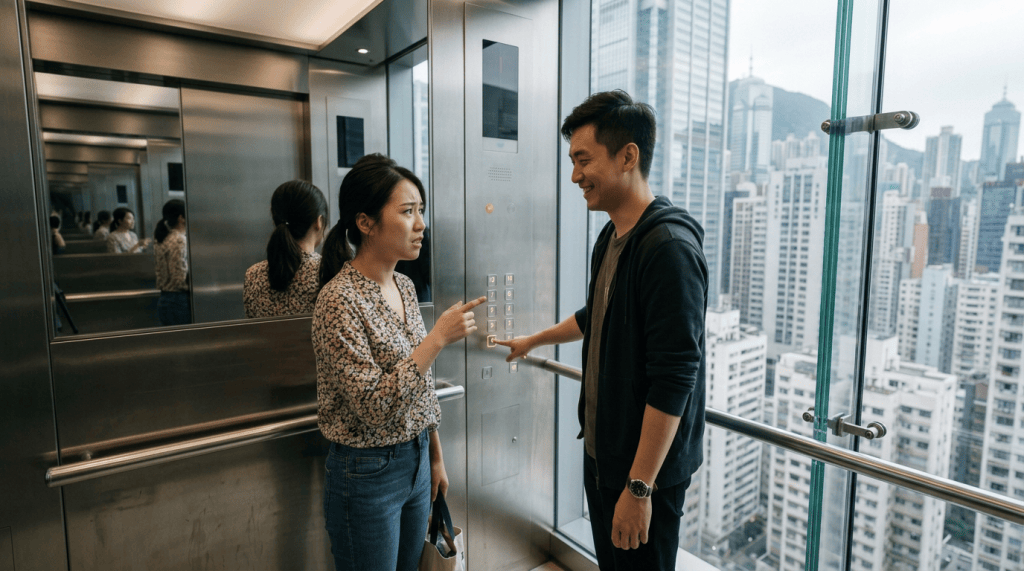
Jason: Why are you staring at the lift buttons like they personally offended you?
Mei: Because this building has a 4th floor.
Jason: Congratulations. You’ve discovered architecture.
Mei: Don’t joke. You know what four sounds like in Cantonese?
Jason: Sei. Death.
Mei: Exactly. That’s why I always avoid anything with 4. In Hong Kong, so many buildings skip 4th, 14th, 24th, 34th floors. Even some hospitals avoid it.
Jason: And yet Hong Kong has somehow survived millions of people saying the word “four” every day.
Mei: That’s not the point. Why take unnecessary risks?
Jason: What risk?
Mei: You’re tempting fate.
Jason: By taking an elevator?
Mei: By choosing the 4th floor when you could choose the 5th.
Jason: Mei, if the universe is going to kill me because I pressed “4” instead of “5,” I think I have bigger problems.
Mei: Laugh all you want. My aunt refused to buy an apartment on the 14th floor. She found one on the 15th instead, even though it cost more.
Jason: Did she get a discount on the extra floor because she survived the number?
Mei: Very funny. Anyway, she said the 14th-floor apartment felt unlucky.
Jason: But did anything bad actually happen to her because of the number 14?
Mei: No.
Jason: Then that’s the important part. You’re treating a coincidence that could happen as evidence that the number causes it.
Mei: You rational people always want evidence. Some things are about cultural experience.
Jason: Cultural meaning is real. A supernatural effect isn’t automatically real just because the culture believes it.
Mei: But look around Hong Kong. Developers deliberately skip these numbers. Why would so many people do that if it meant nothing?
Jason: Because people care about what other people believe. Imagine you’re selling an apartment. If ten buyers think the 14th floor is unlucky, you might label it “15A” so they’ll feel comfortable buying it.
Mei: So you think the floor is secretly still the 14th?
Jason: Of course. The concrete hasn’t moved.
Mei: Hmm.
Jason: And here’s the funny part. If you rename the 14th floor “15A,” the building suddenly becomes spiritually safe?
Mei: Maybe the spirits can’t read English.
Jason: Finally, a loophole.
Mei: Don’t get too excited.
Jason: Think about it another way. Suppose a hospital has fewer rooms numbered 4 or 14. If patients do better in those rooms, does that prove the number is lucky?
Mei: No.
Jason: And if someone dies in a room numbered 4, does that prove the number caused the death?
Mei: Not necessarily.
Jason: Exactly. Death happens because of disease, injury, age and countless biological factors—not because a Cantonese pronunciation happens to resemble a word associated with death.
Mei: But I still wouldn’t want to live on the 14th floor.
Jason: That’s fine. You don’t have to. If the number makes you uncomfortable, choosing another floor can make you happier.
Mei: So you’re saying I can avoid 4 without believing it has supernatural power?
Jason: Exactly. You can respect a tradition without confusing tradition with physics.
Mei: That’s annoyingly reasonable.
Jason: Thank you.
Mei: But I’m still pressing 5.
Jason: Fine. I’ll press 4.
Mei: Don’t!
Jason: Why?
Mei: Because we’re going to the 25th floor. If the lift stops at 4, I’m getting out.
Jason: Mei, that’s not how elevators work.
Mei: You see? Even you admit there are limits to science.
Jason: I admit there are limits to your understanding of elevators.
Mei: Same thing.
Jason: Absolutely not.
Mei: Come on. Take the stairs.
Jason: From the 4th floor?
Mei: Better safe than sorry.
Jason: You know what? For someone afraid of the number 4, you’re very committed to the number 25.
Mei: Twenty-five is a perfectly respectable number.
Jason: I’ll let mathematics know.


Tell Us What You Think