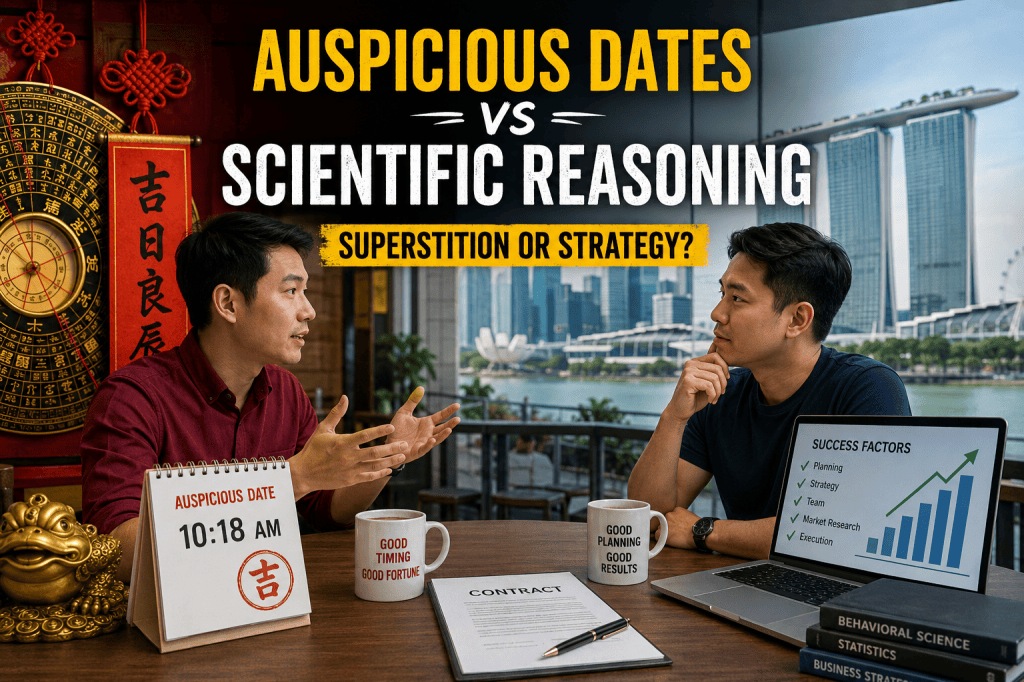
Arjun: You’re telling me the contract signing is next Thursday?
Wei Ming: Yes. At 10:18 a.m.
Arjun: Very precise.
Wei Ming: Of course. It’s an auspicious time.
Arjun: And what happens if you sign at 10:19?
Wei Ming: Don’t joke about it.
Arjun: I’m genuinely asking.
Wei Ming: The feng shui master specifically chose 10:18. He checked the date, the time, the zodiac signs, the energy of the day—everything.
Arjun: So the contract expires if someone arrives late?
Wei Ming: Very funny.
Arjun: I’m serious. Why does 10:18 make the business more likely to succeed than 10:19?
Wei Ming: Because timing matters. You can’t just ignore the energy surrounding an important event.
Arjun: But what exactly is this “energy”? Electricity? Radiation? Gravity?
Wei Ming: You know what I mean.
Arjun: Actually, I don’t. If there’s a physical force affecting the success of a company, we should be able to measure it.
Wei Ming: Not everything important can be measured by your machines.
Arjun: True. But if something is supposed to affect business outcomes, eventually we should see evidence that it does.
Wei Ming: Look at Chinese businesses. Many successful companies choose auspicious dates to open offices, launch products, or sign major agreements. Are you saying all those people are foolish?
Arjun: No. I’m saying a tradition being popular doesn’t establish that it causes success.
Wei Ming: But there are so many examples.
Arjun: Give me one.
Wei Ming: My uncle opened his restaurant on an auspicious date. Business was excellent for years.
Arjun: And?
Wei Ming: And my cousin opened her café on an ordinary date. It struggled.
Arjun: There we go.
Wei Ming: What?
Arjun: Your evidence.
Wei Ming: Exactly!
Arjun: You’ve compared two businesses and decided the date caused the difference. But what about rent, location, food quality, pricing, marketing, staff, competition, customer traffic and management?
Wei Ming: My uncle’s restaurant had good feng shui too.
Arjun: And good food?
Wei Ming: Obviously.
Arjun: Then perhaps the food deserves some credit.
Wei Ming: You scientists always want to remove the mystery from everything.
Arjun: Not mystery. Confounding variables.
Wei Ming: That’s even less romantic.
Arjun: Let me give you an example.
Wei Ming: Go ahead, Professor.
Arjun: Imagine 1,000 companies choose auspicious dates to start their businesses. Five hundred become successful and five hundred fail.
Wei Ming: Okay.
Arjun: Now suppose 1,000 companies choose ordinary dates. Again, 500 succeed and 500 fail.
Wei Ming: So?
Arjun: Then the auspicious date doesn’t appear to make any difference.
Wei Ming: But maybe those 500 successful companies would have failed without the auspicious date.
Arjun: That’s exactly the problem. We need evidence that separates the effect of the date from everything else.
Wei Ming: Businesses aren’t laboratory experiments.
Arjun: They don’t have to be. We can still study patterns statistically.
Wei Ming: But business owners aren’t choosing dates randomly. They believe certain dates are better.
Arjun: Exactly. And that creates another interesting possibility.
Wei Ming: Which is?
Arjun: Maybe the ritual itself changes human behaviour.
Wei Ming: Now you’re agreeing with me.
Arjun: Not quite.
Wei Ming: I knew I’d win eventually.
Arjun: Suppose you sign a contract on a date you believe is lucky. You feel confident. Your employees feel confident. Your partners feel that the company is starting on the right foot. Everyone becomes more motivated.
Wei Ming: Yes.
Arjun: That psychological effect could be real.
Wei Ming: So the auspicious date works.
Arjun: The belief might influence behaviour. That’s different from saying the date itself contains some special force that changes reality.
Wei Ming: What’s the difference if the result is the same?
Arjun: A huge difference. If confidence helps, you could create that confidence without claiming that 10:18 has supernatural business powers.
Wei Ming: You really want to take the magic out of everything.
Arjun: I want to know what actually works.
Wei Ming: I’ll tell you something that happened to me.
Arjun: I’m listening.
Wei Ming: Three years ago, I was negotiating a major partnership. We were supposed to sign on a Friday. My feng shui master told me Friday wasn’t suitable. He said Monday morning would be much better.
Arjun: So you delayed it?
Wei Ming: Yes.
Arjun: And the partnership succeeded?
Wei Ming: Very successfully.
Arjun: What happened during those three extra days?
Wei Ming: We reviewed the contract again.
Arjun: Anything else?
Wei Ming: We changed two clauses.
Arjun: Important clauses?
Wei Ming: Quite important.
Arjun: Then maybe those three days helped.
Wei Ming: Perhaps.
Arjun: Your feng shui master accidentally bought you time for better due diligence.
Wei Ming: Don’t say “accidentally.” He knew the timing was right.
Arjun: Fair enough. But that’s precisely why anecdotes aren’t enough.
Wei Ming: Fine. But you have your own superstitions.
Arjun: Such as?
Wei Ming: You always wear that same blue shirt when you give an important presentation.
Arjun: That’s because it’s comfortable.
Wei Ming: And you once refused to change your presentation slides five minutes before a meeting because you said, “Don’t touch anything now.”
Arjun: That’s risk management.
Wei Ming: Sounds suspiciously like superstition.
Arjun: There is a difference.
Wei Ming: Explain.
Arjun: If I believe changing the slides five minutes before a meeting increases the probability of making a mistake, that’s based on a reasonable causal mechanism. If I believe changing them will anger the universe, that’s superstition.
Wei Ming: Hmm.
Arjun: You can challenge my assumption. That’s science.
Wei Ming: And I can challenge yours.
Arjun: Absolutely.
Wei Ming: Maybe one day science will discover that there are things we don’t understand about timing.
Arjun: That’s possible.
Wei Ming: So you admit it!
Arjun: I admit that science doesn’t know everything. I don’t admit that an unsupported claim is true just because we haven’t disproved it.
Wei Ming: That’s annoyingly reasonable.
Arjun: It’s a terrible personality trait. I know.
Wei Ming: Still, I’m signing my next contract at 10:18.
Arjun: Fine.
Wei Ming: You won’t stop me?
Arjun: No.
Wei Ming: Why not?
Arjun: If choosing 10:18 makes you happy and doesn’t cause you to ignore the actual business risks, go ahead.
Wei Ming: So you approve?
Arjun: I approve of checking the contract, the finances, the market and the legal terms.
Wei Ming: And 10:18?
Arjun: If it makes you sleep better, sure.
Wei Ming: Excellent.
Arjun: Just promise me one thing.
Wei Ming: What?
Arjun: If the meeting is at 10:18, don’t fire your lawyer because his zodiac sign is incompatible with yours.
Wei Ming: I wasn’t going to.
Arjun: Good.
Wei Ming: I was going to fire him because he’s expensive.
Arjun: Now that is a scientifically defensible decision.
Wei Ming: Fine. But I’m still signing at 10:18.
Arjun: And I’ll arrive at 10:17.
Wei Ming: Why?
Arjun: Because I’m not taking the chance that your feng shui master has a rule about people arriving late.
Wei Ming: See? You’re learning.
Arjun: Don’t push it.
 Science Vs Superstition
Tell Us What You Think