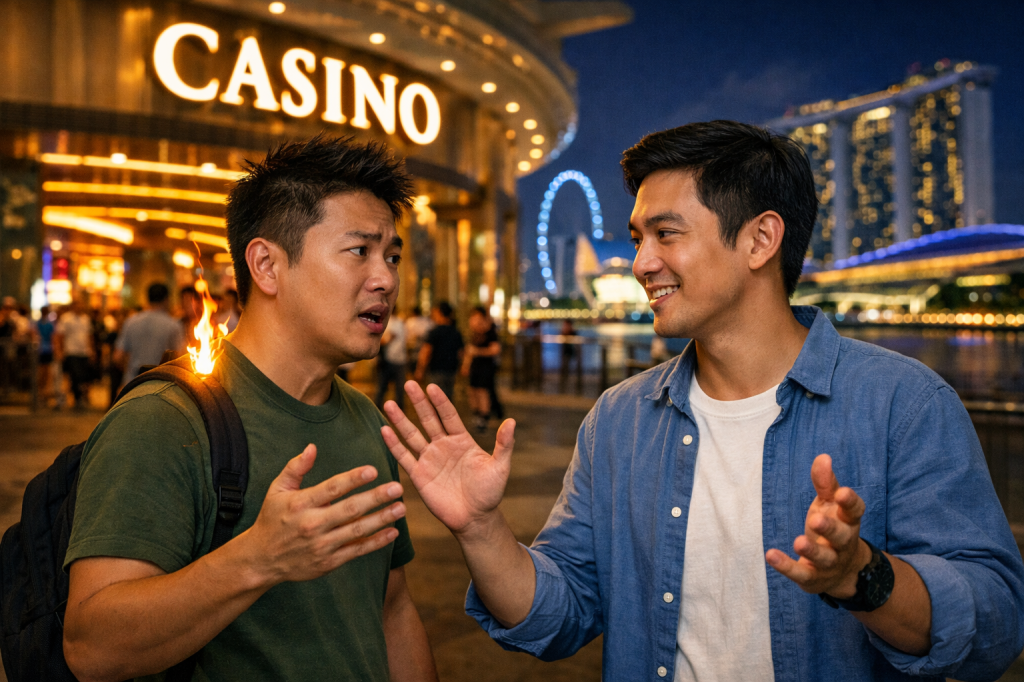
Setting: Outside a casino in Marina Bay, Singapore.
Ben (superstitious): Eh, don’t stand so close lah. If you tap someone’s shoulder while they’re gambling, you’ll extinguish their “fire.” Then sure lose one.
Arjun (rational): Extinguish their fire? What is this, Dragon Ball Z ah? Since when does a human shoulder have a candle on it?
Ben: You joke only. My uncle told me. In gambling, people have “huo”—luck energy. If someone taps you from behind, it disrupts the flow. Very bad omen.
Arjun: Or maybe it just distracts them for two seconds and they make a bad decision.
Ben: No, no. I’ve seen it happen. Last year at Resorts World, this guy was on a winning streak at baccarat. My cousin tapped him to say hello. After that? Boom. Lost five rounds straight.
Arjun: That’s called probability, my friend. Baccarat has fixed odds. You win, you lose. The tap didn’t change the math.
Ben: But the timing was too coincidental!
Arjun: That’s exactly why it feels powerful. Our brains love patterns. If he kept winning after the tap, you wouldn’t even remember it.
Ben: Still… why take the risk? Just don’t tap. Better safe than sorry.
Arjun: By that logic, we shouldn’t blink near gamblers either. Later you say we blew away their luck with our eyelashes.
Ben (laughing): Aiyo, don’t exaggerate lah.
Arjun: I’m serious. Think about it. If tapping truly “extinguished flames,” casinos would ban it officially. There’d be signs everywhere: “No Shoulder Tapping—Affects Luck.”
Ben: Maybe they don’t want to admit it.
Arjun: Or maybe because it’s not real. Casinos make money from statistics, not supernatural shoulder physics.
Ben: But culture matters. Even croupiers sometimes avoid touching players.
Arjun: That’s psychology. If a player believes their luck is gone, they’ll play differently—more desperate, more emotional. That changes outcomes. Not the tap itself.
Ben: So you’re saying it’s self-fulfilling?
Arjun: Exactly. If someone thinks their “fire” is out, they lose confidence. In gambling, mindset affects risk-taking. That’s behavioral economics, not spirits.
Ben: Hmm. But my grandmother always said luck is like a candle flame.
Arjun: That’s a nice metaphor. But metaphors don’t alter probability distributions.
Ben: Wah, now you sound like a statistics professor.
Arjun: Maybe I missed my calling. But really—if tapping caused losses, we could run an experiment. Two groups of gamblers. Tap one group randomly, leave the other alone. Track results.
Ben: You want to get chased out by security ah?
Arjun: For science, maybe.
Ben (grinning): You’re crazy.
Arjun: Think about this—when someone loses after being tapped, everyone blames the tap. When they win after being tapped, nobody says, “Wah, that tap boosted the flame!”
Ben: True… I never heard that version.
Arjun: That’s confirmation bias. We only remember events that fit the story.
Ben: But still, I won’t tap. I respect their belief.
Arjun: That part I agree with. Not because of flames—but because it’s polite not to disturb someone concentrating.
Ben: So you admit tapping is bad!
Arjun: Bad manners, not bad luck.
Ben: Hmm… okay, maybe the “flame” thing is symbolic. But I still won’t risk being the reason someone blames me for losing $10,000.
Arjun: That’s fair. In Singapore, people can be very serious about their luck.
Ben: Exactly. If the guy turns around and glares at me, I don’t want to say, “Actually it’s just probability.”
Arjun: You can say, “Bro, it’s regression to the mean.”
Ben: Confirm kena punch.
Arjun (laughing): Fine, we agree on one thing—don’t tap gamblers. But not because of invisible candles. Because humans are emotional creatures.
Ben: Okay lah. Maybe the real “fire” is confidence.
Arjun: Now that I can accept.
Ben: But if you ever tap me when I’m winning 4D, our friendship is over.
Arjun: Deal. I’ll stand two meters away—with scientifically neutral hands.


Tell Us What You Think