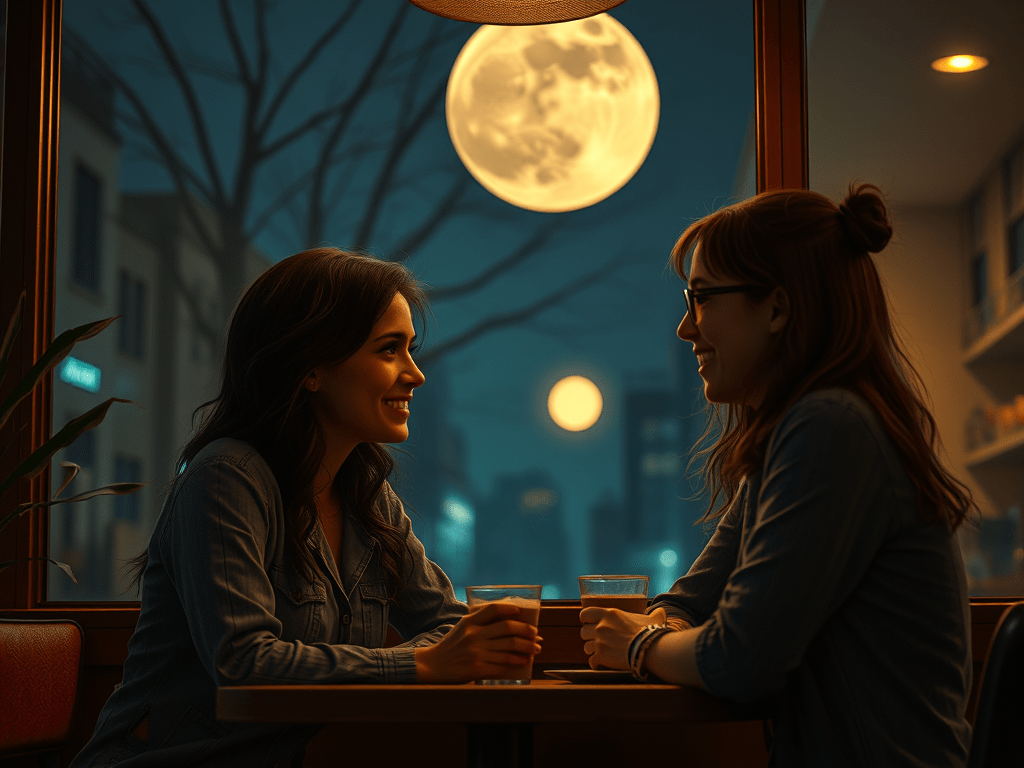
Setting: Two friends, Lena (the superstitious one) and Rachel (the rational thinker), are sitting in a hospital café in Chicago, sipping coffee during a late evening visit to see a mutual friend who just had surgery. It’s a full moon outside, glowing ominously through the window.
Lena: (glancing nervously at the window) You know we shouldn’t be here right now. It’s a full moon. Weird stuff always happens in hospitals during full moons. Remember last year? That nurse tripped over a mop bucket and ended up in the ER herself!
Rachel: (chuckling) Lena, that could happen any day. People trip over things. Mop buckets are neutral entities—they don’t get powered up by moonlight.
Lena: Oh come on, Rachel. You can’t tell me you’ve never noticed how the ER feels off during a full moon. Ask any nurse or paramedic. They’ll tell you the same thing—more patients, crazier cases, more chaos.
Rachel: I’ve asked. I even looked it up because of you. There are dozens of studies that analyzed ER data over years, and most found no significant increase in cases during full moons. It’s just confirmation bias. You remember the wild nights and forget the normal ones.
Lena: Confirmation bias? Is that like… when my horoscope tells me I’ll have a stressful day, and then I do?
Rachel: Exactly! It’s like you’re looking for stress because you expect it. Same with full moons. The moon doesn’t make people trip, yell, or deliver babies faster.
Lena: Then why do all the nurses I know swear it’s real? You can’t tell me everyone in scrubs is imagining it.
Rachel: They work long, chaotic shifts, and full moons stand out. It’s like how people swear that bad things come in threes. We love patterns—even if they aren’t there. You’re not gonna like this, but a 2004 study analyzed over 70,000 emergency calls and found no correlation with lunar phases.
Lena: Seventy thousand? That’s… a lot of data. But didn’t that study come from New York? Chicago might be different. Our full moons hit harder. We’re closer to Lake Michigan. More moon reflection or something.
Rachel: (laughing) Wow, Lena, that’s a creative twist. “Lunar amplification by lake.” You should write a paper on that.
Lena: Don’t tempt me. I might go viral. You’ll be laughing till I end up on The View explaining moon-lake synergy.
Rachel: I’d watch that. But seriously, doesn’t it ever bother you that superstitions can make us paranoid? I mean, what if one day you avoid seeing a doctor when you really need to—just because the moon is full?
Lena: I’d probably still go. I’m superstitious, not stupid. But it’s not all bad, you know? Superstitions give life a little… flavor. You get to tell stories, feel connected to old traditions. It’s kinda romantic, in a spooky way.
Rachel: I get that. Humans have always told stories about the moon—it’s mysterious, and we like mystery. But I just think it’s more empowering to rely on facts. Like, we’ve been to the moon. We’ve studied its gravitational effects. No credible evidence says it messes with human behavior.
Lena: Except tides. It messes with water. And we’re, like, 70% water. Maybe it messes with us too, just subtly.
Rachel: That “we’re made of water” argument again? So is soup. You ever see a full moon make chicken noodle act up?
Lena: Don’t sass the soup. You’ll anger the lunar spirits.
Rachel: (grinning) I’m pretty sure the only spirits around here are in that janitor’s hip flask.
Lena: Okay, okay. I’ll admit… maybe the full moon thing is more psychological than cosmic. But if a patient turns into a werewolf tonight, I’m calling it.
Rachel: Deal. If anyone sprouts fur, I’ll buy you lunch for a week. But if nothing happens—no chaos, no mystery—you owe me one “Rachel was right” speech, and no complaints about the moon next time.
Lena: Fine. But if a cat walks across this hospital’s entrance backward, I’m out of here.
Rachel: (raising her coffee cup) To the moon—source of tides, poems, and absolutely no ER drama.
Lena: (raising hers too) To irrational fears… and good friends who put up with them anyway.


Tell Us What You Think