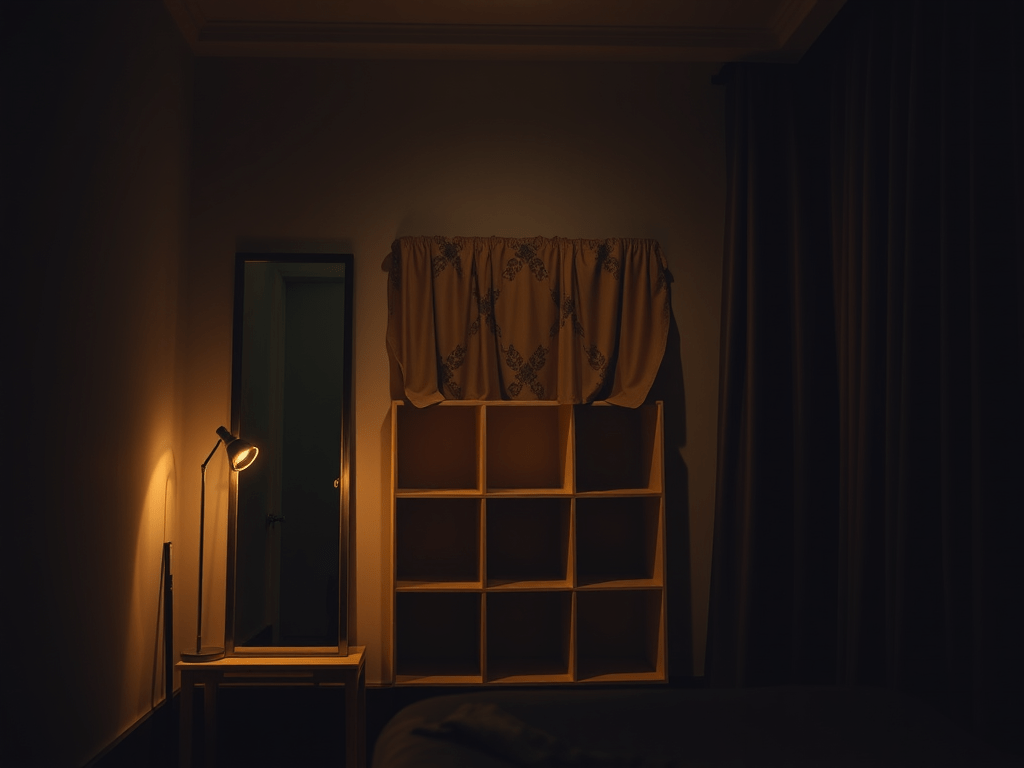
Scene: Mei Ling’s HDB flat in Tampines, around 10:30 PM. Arjun is helping her assemble a new IKEA shelf.
Mei Ling: Wait, wait—don’t leave that mirror facing the bed like that!
Arjun: (holding screwdriver) Why? It’s just reflecting my very tired face.
Mei Ling: I’m serious. At night you must cover mirrors in the bedroom. Spirits can use them to enter and disturb your soul while you’re sleeping.
Arjun: Ah, the mirror-portal theory again. Is this from your grandmother?
Mei Ling: Yes! My ah ma always said mirrors are gateways. She told me once her cousin saw a “shadow” moving in the reflection at 3 a.m. After that, they covered all mirrors before sleeping.
Arjun: 3 a.m.—the classic horror movie timing. Maybe the cousin was half asleep? When you wake up during REM sleep, your brain can still project dream images. It’s called hypnopompic hallucination.
Mei Ling: Hypno-what?
Arjun: Hypnopompic. It happens when your brain hasn’t fully switched from dreaming mode to awake mode. You can see shadows, figures, or movements. If there’s a mirror reflecting dim light, your brain might misinterpret shapes.
Mei Ling: But why mirrors specifically? Why not walls?
Arjun: Because mirrors reflect subtle movement—curtains, passing car headlights, even your own shifting. In low light, your brain struggles to process details. There’s even something called the “strange-face illusion.” If you stare into a mirror in dim light long enough, your face starts looking distorted.
Mei Ling: That sounds worse! You’re proving my point.
Arjun: No, I’m proving it’s your brain, not spirits. Our brains are pattern-detection machines. When information is incomplete, it fills in the gaps.
Mei Ling: Still… I don’t like the feeling. Last year, when I stayed at that hotel in Orchard, there was a big mirror facing the bed. I kept waking up feeling uneasy.
Arjun: Could be psychological. If you already believe mirrors are dangerous at night, your anxiety goes up. Anxiety disrupts sleep. Then you wake up tired and blame the mirror.
Mei Ling: So you’re saying it’s all in my head?
Arjun: Not “all in your head” like you’re imagining things. Just that your brain is powerful. It reacts to beliefs. If you think something is threatening, your body goes into alert mode.
Mei Ling: Hmm. But many cultures say mirrors are spiritual objects. During funerals, some people even cover mirrors.
Arjun: That’s true. Historically, mirrors were rare and mysterious. Before modern science, reflections seemed magical—like a second self trapped in glass. It’s natural people created stories around them.
Mei Ling: So you’re saying it’s cultural psychology?
Arjun: Exactly. Traditions often start as symbolic protection. Over time, they become literal beliefs.
Mei Ling: But what if there is something we don’t understand yet? Science doesn’t know everything.
Arjun: True, science doesn’t know everything. But it works on evidence. If mirrors were portals, we’d see measurable effects—temperature changes, energy fluctuations, something consistent.
Mei Ling: Maybe spirits are shy.
Arjun: (laughs) Very considerate spirits. Only active when aunties are around.
Mei Ling: Eh! Don’t joke. I’m serious.
Arjun: Okay, serious mode. If covering the mirror helps you sleep peacefully, that’s fine. But it’s for comfort, not because of spirits.
Mei Ling: So you’re okay with me covering it?
Arjun: Of course. Sleep quality matters. If a cloth over the mirror reduces anxiety, that’s practical psychology.
Mei Ling: Wah, now you sound like you’re half-converted.
Arjun: No, I’m saying the benefit is emotional, not supernatural.
Mei Ling: But you won’t cover your mirror at home, right?
Arjun: Nope. Mine reflects my laundry pile. Very scary, but not spiritual.
Mei Ling: (laughs) Okay, fine. Maybe I’ll experiment. Tonight I won’t cover it.
Arjun: That’s brave.
Mei Ling: If I see something, I’m calling you.
Arjun: If you see something, check whether it’s your own reflection first.
Mei Ling: You know what’s funny? Even though I believe this, talking to you makes me question it.
Arjun: That’s good. Questioning doesn’t mean disrespecting tradition. It just means understanding why we follow it.
Mei Ling: Maybe traditions were just ways to help people feel safe in uncertain times.
Arjun: Exactly. And now we have LED lights, neuroscience, and Shopee deliveries. Slightly less mysterious world.
Mei Ling: Okay lah. I’ll leave the mirror uncovered tonight. But if anything happens, you’re staying over tomorrow.
Arjun: Deal. But if nothing happens, you owe me bubble tea.
Mei Ling: Fine. And if a spirit appears?
Arjun: Then I’ll write a scientific paper.
Mei Ling: Confirm viral.
Arjun: In Singapore? Confirm got aunties forming a WhatsApp group.
Mei Ling: (laughing) Okay, okay. Let’s see who wins—science or spirits.
Arjun: My money’s on sleep psychology.
The room grows quiet as they finish assembling the shelf. Mei Ling glances once at the mirror—then shrugs.
Mei Ling: You know what? It’s just glass.
Arjun: Exactly.
Mei Ling: …Still a bit creepy though.
Arjun: That’s just your brain doing special effects. Free horror package included.
They both laugh, the mirror quietly reflecting nothing more than two friends and a very ordinary bedroom.
 Science Vs Superstition
Tell Us What You Think