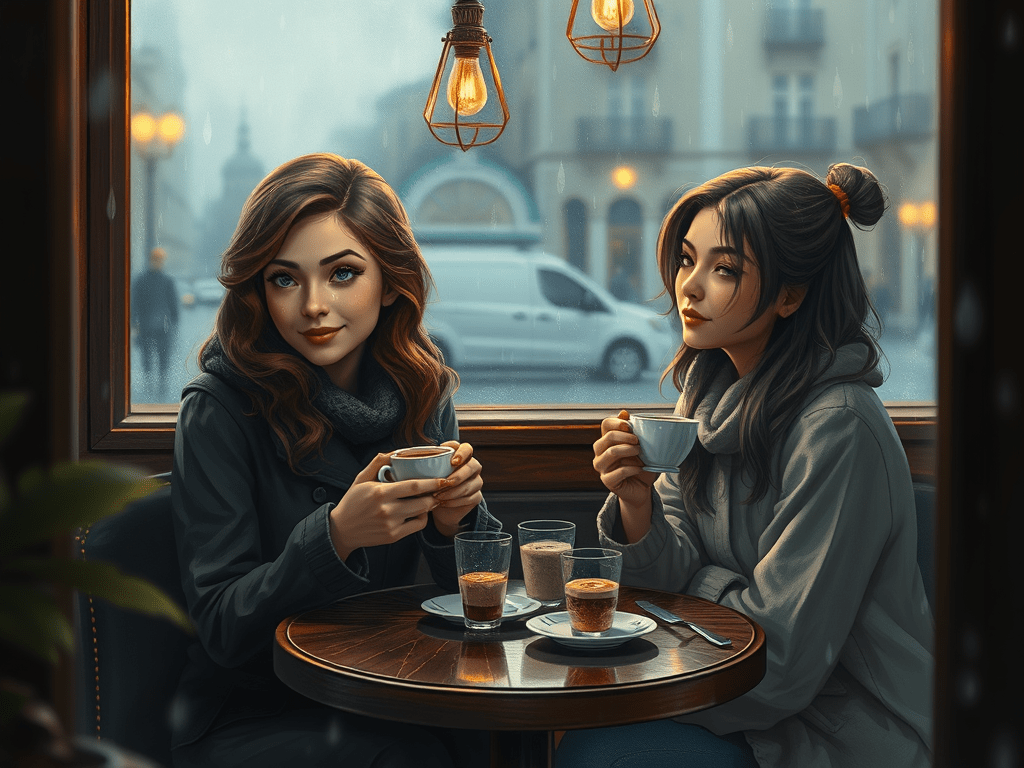
Setting: A cozy café in Oviedo, Asturias. The weather is cloudy, with light rain tapping on the windows. Two lifelong friends, Sofía (the superstitious one) and Clara (the rational one), are sitting by the window with café con leche and slices of almond cake.
Sofía: (whispering while glancing outside) Clara… did you hear about what happened to Marta’s uncle in the village last week?
Clara: (grinning) If it starts with a strange noise in the woods and ends with “and then they saw La Güestia,” I’m getting up and ordering more coffee.
Sofía: I’m serious! He was walking home from the tavern in Taramundi at midnight and saw a line of ghostly figures in white robes carrying candles. He said he froze on the spot. Couldn’t move. That’s classic Güestia behavior.
Clara: Or classic “too much cider and a foggy night” behavior. Come on, Sofía. You know what fog can do when the moonlight hits it right? It can make cows look like cloaked monks.
Sofía: You always say that! But how do you explain that he felt cold suddenly? Like… a deep chill in his bones? And he says they vanished when he made the sign of the cross.
Clara: Ah yes, the ol’ “sign of the cross defeats spectral procession” clause. Okay, let me ask you this—why is it always someone’s uncle or cousin or a friend’s neighbor who sees these things? Never the person telling the story?
Sofía: Because the spirits choose who they reveal themselves to. It’s not like they want a spotlight on YouTube. They’re ancient. Secretive.
Clara: Or, people love a good story, especially when it’s dark and foggy in the mountains. Our brains are wired to find patterns—even when they’re not there. It’s called pareidolia—seeing faces or figures in randomness. Like seeing the Virgin Mary in a burnt tortilla.
Sofía: That’s not funny. You’d change your tune if you spent a night in that Galician forest near Pontevedra. My cousin swears she heard the Santa Compaña once—bells ringing, footsteps behind her. She ran all the way home.
Clara: Again with the cousins! Look, Sofía, I get it. It’s comforting in a weird way, having these stories. They’re part of our culture, and they’re beautifully creepy. But believing that hooded soul-collectors roam the hills… don’t you think there’d be better evidence than third-hand stories and “strange feelings”?
Sofía: What kind of evidence do you expect? You want one of the spirits to pose for a selfie with GPS coordinates?
Clara: Yes. Preferably with today’s newspaper.
(They both laugh.)
Sofía: Okay, fine. Maybe some of it is… folklore. But you can’t deny that people have experienced something. I mean, why would so many believe in them across generations?
Clara: Because humans pass on stories that help explain the unknown. In the past, if someone died mysteriously, people blamed spirits—because they didn’t have doctors or meteorologists. Now we have science. And electricity. And forensic pathology.
Sofía: But science can’t explain everything. Like when my plants wilt overnight for no reason… I swear it’s because I offended a local spirit.
Clara: Or maybe you forgot to water them and there was a frost warning. Want me to get you a thermometer and a calendar?
Sofía: (smiling) You and your gadgets. One day, Clara, you’ll meet one of them. And when La Güestia knocks on your window, don’t come running to me.
Clara: If La Güestia knocks, I’ll offer her some almond cake and ask if she wants to participate in a double-blind scientific study.
Sofía: And then you’ll vanish mysteriously.
Clara: Only if I forget to pay my rent.
 Science Vs Superstition
Tell Us What You Think