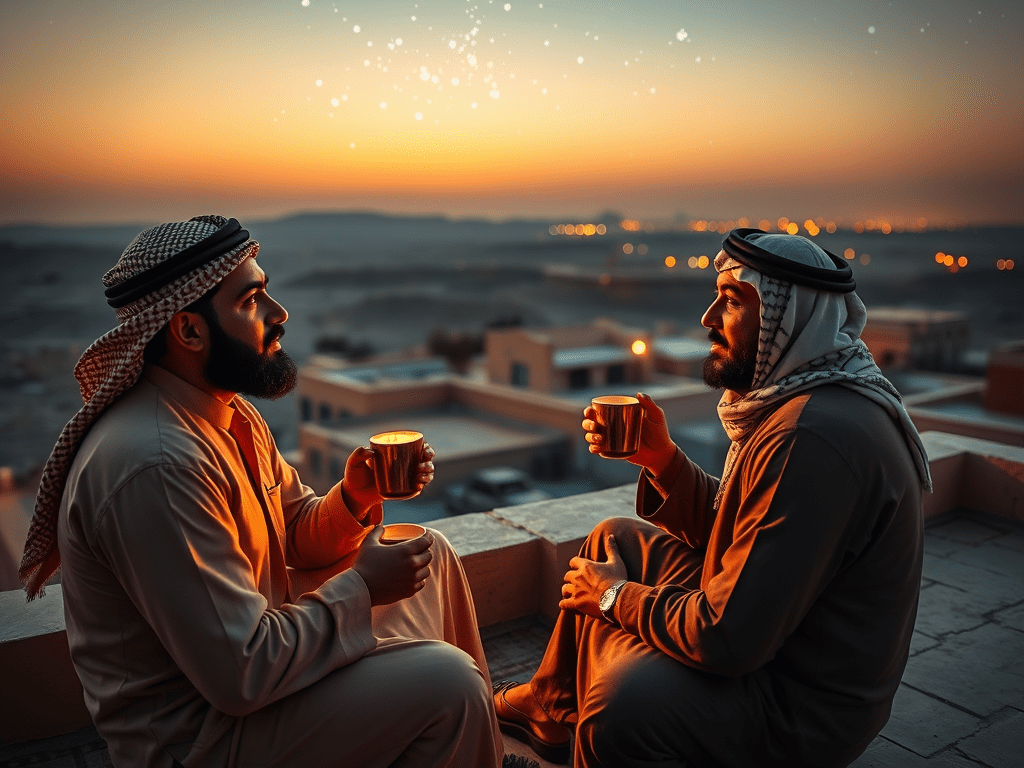
[Scene: A breezy evening in Riyadh. Fahad and Salem are sitting on the rooftop sipping Arabic coffee and watching the stars.]
Salem: (narrowing his eyes) You see that wadi down there? My cousin swears he saw a jinn with red eyes sitting on a rock there once. That’s why they say kids shouldn’t go wandering around at night.
Fahad: (laughs) Salem, that “jinn” was probably just a red soda can reflecting moonlight. Or his imagination running wild. You know how your cousin is.
Salem: (offended but amused) Hey! Talal is not that imaginative. And you think all these stories are just made up? Come on, you’ve heard the tale of Umm Al-Duwais, right? The beautiful woman who appears to lone men and then—bam!—turns into a monster?
Fahad: (chuckles) Of course I’ve heard it. But let me guess: it’s always “a friend of a friend” who saw her, right? These stories are old-school parenting tricks. Scare kids into behaving. No GPS, no cell phones back then — they had to use fear to keep children safe.
Salem: Exactly! So you agree! These stories work. They’ve been passed down because they protect us.
Fahad: I agree that they were effective at the time. But we don’t need to scare kids with supernatural horror when we can just teach them the real dangers — like dehydration, wild animals, or getting lost in the desert. Facts scare me more than fiction, honestly.
Salem: But facts are boring! “Don’t go out or you’ll be tired and thirsty” doesn’t have the same impact as “Don’t go out or the jinn will chase you into the dunes and eat your soul!”
Fahad: (laughing) That’s exactly the problem! You end up with a generation of adults still afraid of going near a bush because it “might be cursed.” Remember when we didn’t take that shortcut during our camping trip because you thought the tree was possessed?
Salem: That tree was creepy. It had goat bones at the base and that weird smell…
Fahad: It was a goat skull from a barbeque. And the smell was rotten dates, not dark magic.
Salem: You hope it was dates. But how do you explain what happened to my uncle Mansour when he tried to build his farm near that abandoned well?
Fahad: (sips coffee) Oh, the one where all his goats got sick? That wasn’t a curse. It was because he didn’t vaccinate them, and the water was contaminated. I read the vet report!
Salem: Still… spooky timing. You have to admit, sometimes science doesn’t explain everything.
Fahad: True, but just because science hasn’t explained something yet doesn’t mean jinn or ghosts are the answer. That’s like hearing a noise in the house and assuming it’s a vampire before checking the plumbing.
Salem: So you’re saying all these stories my grandmother told me — they’re just nonsense?
Fahad: Not nonsense. They’re part of your culture. Our shared culture. They’re stories with value, but not necessarily truth. They kept kids safe, brought families together at night, and made sure people respected nature. But it doesn’t mean there’s a jinn behind every palm tree.
Salem: (smiling) So… I can tell my nephew not to go out at night because of wild dogs instead of a date-devouring ghoul?
Fahad: Much better. Though if you want to throw in a creepy twist for entertainment, I won’t stop you.
Salem: (grinning) What about a rabid dog possessed by a jinn?
Fahad: You’re impossible.
Salem: But admit it — you’d totally watch that movie.
Fahad: Okay, yes. But only if I get to write the ending — where the scientist saves the day with a flashlight and a vaccine.
Salem: Deal. But the jinn still gets one jump scare. Just one.
[They both laugh, sipping the last of their coffee as a breeze rustles the palm trees below.]
Salem: Just don’t ask me to go near that wadi, bro. Not after sunset.
Fahad: Fine. But only because I heard there are actual snakes down there. Not spirit-snakes. Real ones.
Salem: (shudders) Okay, science wins this round.
[End Scene]
 Science Vs Superstition
Tell Us What You Think