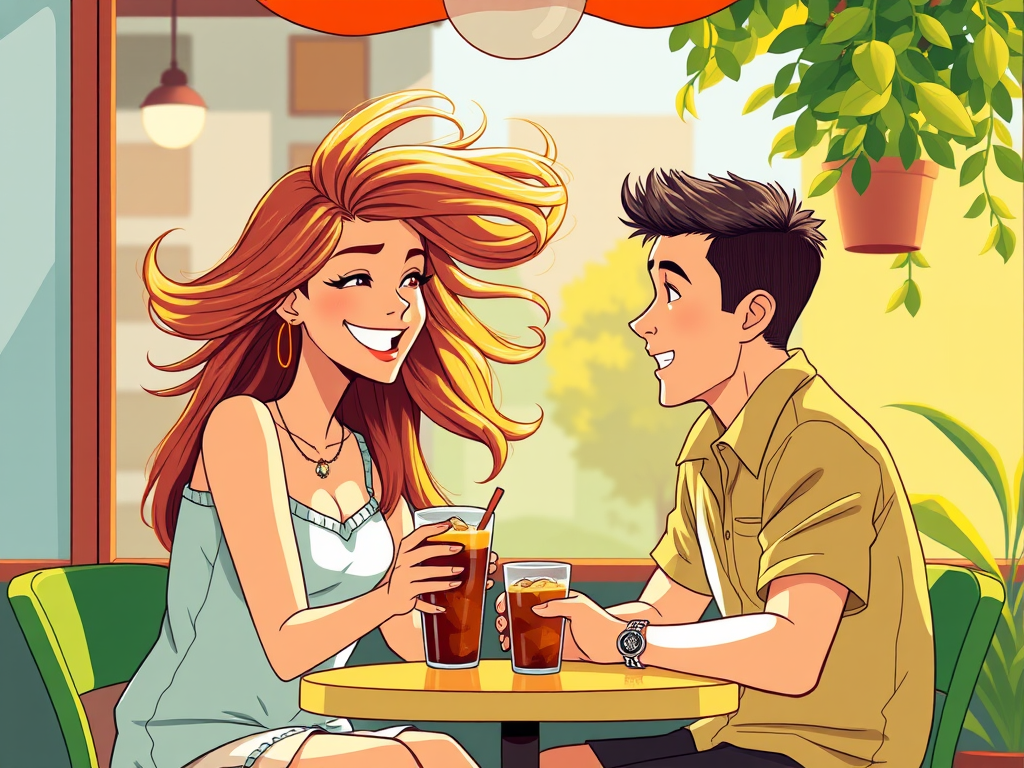
Setting: A sunny afternoon in São Paulo. Two friends, Lúcia (the superstitious one) and Marcos (the rational thinker), are sitting at a small café sipping guaraná and catching up.
Lúcia: (flipping her hair dramatically) Marcos, I finally cut my hair last night. Full moon, just like my aunt taught me.
Marcos: Oh boy… not the moon again. So, let me guess, it’ll grow faster, shinier, and attract your soulmate?
Lúcia: (grinning) Exactly! You joke, but it’s true. My cousin Vanessa swears by it. She cut hers during the waxing moon and boom — two weeks later, it was longer and her ex came crawling back.
Marcos: Sounds like her shampoo did the heavy lifting, not the moon. Or maybe her ex is just chronically indecisive.
Lúcia: Ha! You’re just jealous of ancient wisdom. Science can’t explain everything, meu amigo.
Marcos: Actually, science tries to explain everything. That’s kind of the point. Lúcia, hair growth is controlled by biology — hormones, nutrition, genetics. The moon affects tides because of gravity. Your scalp isn’t the Atlantic Ocean.
Lúcia: But we’re made of water, aren’t we? Like, 70% or something? So the moon must affect us too.
Marcos: That’s a classic one! Yes, we’re full of water, but the moon’s gravitational pull on individual humans is basically negligible. I mean, if it could pull your hair out of your head, I’d be bald every full moon.
Lúcia: You are thinning on top, actually.
Marcos: That’s genetics, thank you very much — not the lunar calendar.
Lúcia: Okay, Mr. Logic. But explain this: every time I cut my hair during the waning moon, it feels… dead. Like, the ends split faster. But during the waxing moon? It grows beautifully.
Marcos: That’s classic confirmation bias. You expect it to grow better, so you notice when it does. But when it doesn’t, you forget or blame something else — like Mercury being in retrograde or whatever.
Lúcia: Don’t bring Mercury into this. That’s a different energy.
Marcos: (laughs) Lúcia, just do a little experiment. Cut one side of your hair during a waxing moon and the other during a waning moon. Then wait.
Lúcia: Are you insane? I’m not walking around São Paulo with a lunar mullet!
Marcos: Come on, for science!
Lúcia: For embarrassment, you mean. Listen, I know you don’t believe in this stuff, but for me, it’s about more than just growth. It’s about rhythm, tradition… connecting to something bigger than myself. It makes me feel aligned, you know?
Marcos: I get that. Rituals do have psychological value. But don’t confuse the comfort of the ritual with evidence that it’s doing what you think it’s doing. There’s a difference between feeling better and actual cause-and-effect.
Lúcia: Maybe. But I’d rather trust my grandma’s hair calendar than some lab study done on bald rats.
Marcos: Fair enough. But if I show you a peer-reviewed paper proving moon phases don’t affect hair growth, will you consider at least questioning the tradition?
Lúcia: Hmm. Only if you cut your own hair during Mercury retrograde and let me film it.
Marcos: Deal. But I’m warning you, if my hair turns into a cosmic antenna, I’m suing you for witchcraft.
Lúcia: (laughing) And if it grows beautifully, I’m writing a book: “Lunar Locks: The Hair Chronicles.”
Marcos: Sounds like a bestseller. But remember — just because something feels magical doesn’t mean it is magical.
Lúcia: And just because something lacks data doesn’t mean it’s meaningless.
Marcos: Touche. At least we can agree your hair looks great — even if we disagree on why.
Lúcia: Now that’s some good energy. Want to help me choose a moon phase for eyebrow threading?
Marcos: Lord, help me.
[End scene]
 Science Vs Superstition
Tell Us What You Think