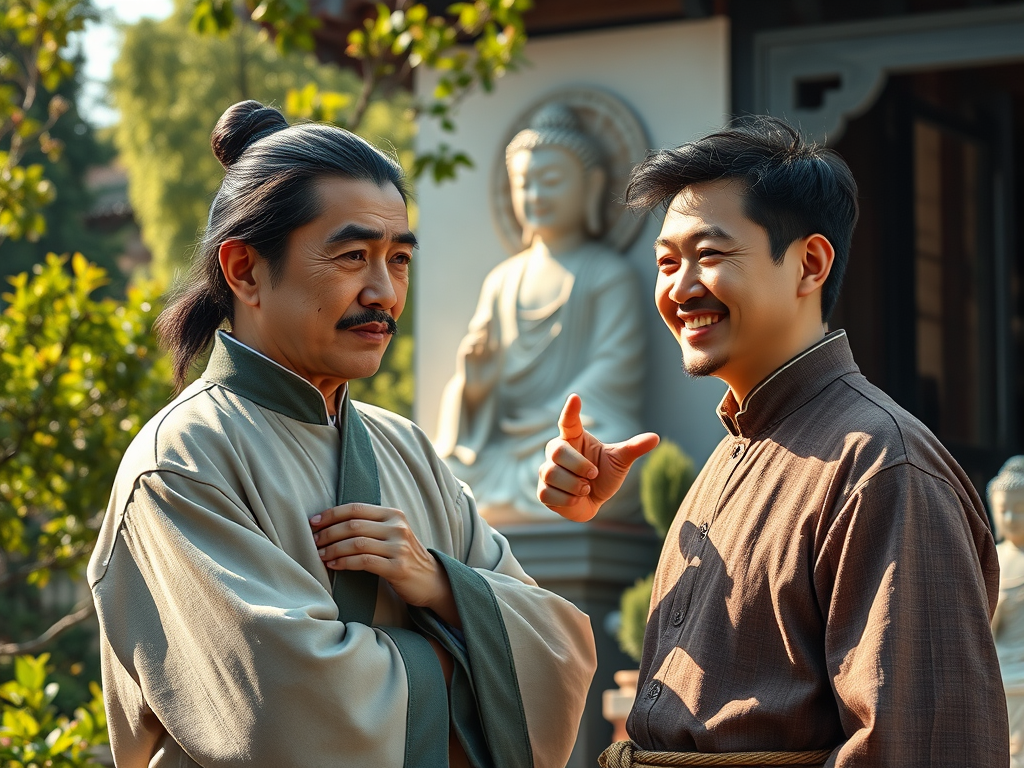
[Scene: A sunny afternoon at the Lingyin Temple in Hangzhou. Li Wei and Chen Hao are strolling through the temple grounds, admiring the intricate Buddha statues. Li Wei stops suddenly as Chen Hao raises his index finger toward one statue.]
Li Wei (gasps):
Hao! Don’t do that! You must never point at a Buddha statue with your index finger!
Chen Hao (raising an eyebrow, smiling):
Huh? Why not? I was just pointing out the detail on the lotus base — look at that carving!
Li Wei (grabbing his arm):
No, no, no! It’s disrespectful. My grandmother always told me — if you point at Buddha, you’ll offend the spirits and have bad luck. Use your whole hand or your thumb if you must gesture.
Chen Hao (grinning):
So the spirits are up there keeping score? “Ah, Chen used his index finger today — mark him down for three days of bad luck”? Come on, Wei. You know I’m a science guy.
Li Wei (serious):
It’s not just superstition, Hao. It’s about respect! Imagine someone pointing their finger in your face — doesn’t it feel aggressive?
Chen Hao:
Fair point. But if a foreign tourist points accidentally, do you think the Buddha cares? He’s supposed to be the embodiment of compassion and enlightenment, not an angry schoolteacher handing out detention slips.
Li Wei (chuckling):
Maybe, but why take the risk? I once pointed at a Buddha in Thailand when I was 18 — that week, I slipped on wet tiles, my phone fell in a pond, and my girlfriend dumped me. Coincidence?
Chen Hao (laughing):
That’s definitely coincidence! Or maybe the phone and the girlfriend were working together — Buddha’s innocent here.
Think about it: billions of people around the world don’t even know this custom. If pointing were truly cursed, we’d have global chaos every day!
Li Wei:
But these traditions go back centuries, Hao. There must be some truth behind them. Why else would people in China, Thailand, Japan, all believe this?
Chen Hao:
Traditions survive not always because they’re factually true, but because they serve a social purpose. In this case, maybe the rule taught people to be mindful and respectful in sacred spaces. That’s useful! But it doesn’t mean Buddha’s handing out parking tickets from the afterlife.
Li Wei (half-smiling):
Hmm… you make a good point. But still, when you live with these ideas your whole life, they feel real. Like how my mom won’t sweep the floor on Chinese New Year — she says it sweeps away good luck. I know it’s silly, but I still avoid it.
Chen Hao:
Fair enough. I don’t want to be the guy who stomps all over your family traditions.
But maybe we can think of it like this: follow the custom if it helps you feel connected and respectful — but don’t let it scare you. You’re in charge of your life, not a finger-wagging Buddha.
Li Wei (laughing):
Fine, fine. Just promise me, if you want to point at something here, do it like this. [He points with his thumb, giving an exaggerated, goofy grin.]
Chen Hao (mimicking him):
Like this? [Waving his thumb dramatically] Look, Wei! The majestic Buddha!
Li Wei (laughing so hard he nearly drops his camera):
You’re impossible, Hao. But okay… I admit, it’s more about me than about Buddha.
Chen Hao (smiling warmly):
Exactly. And hey, I’ll respect the tradition while we’re here — not because I fear cosmic punishment, but because I respect you. Deal?
Li Wei:
Deal. But just so you know, if your phone ends up in the pond today… don’t say I didn’t warn you.
Chen Hao (grinning):
Noted, Professor Wei. I’ll keep my thumb at the ready.
[They walk off together, laughing and playfully pointing with their thumbs at everything from koi fish to temple lanterns.]
 Science Vs Superstition
Tell Us What You Think