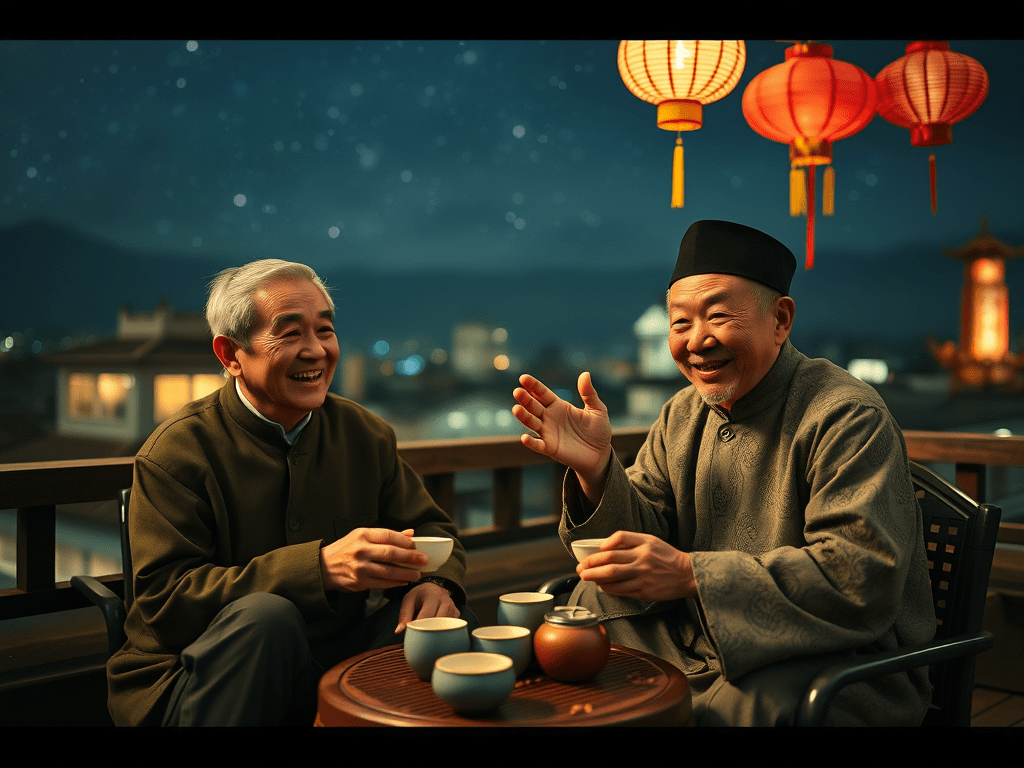
Setting:
It’s a quiet evening in a small town in Yunnan, China. Two old friends, Li Wei (the rational thinker) and Chen Jie (the superstitious one), are sitting on a rooftop sipping jasmine tea and enjoying the cool breeze.
Chen Jie:
(shivering a little) Li Wei, don’t call out my name like that at night, ah! What if a wandering ghost hears and comes looking for me?
Li Wei:
(laughing) Jie, seriously? We’re just two guys drinking tea on a rooftop. I doubt a ghost’s gonna eavesdrop on our conversation like it’s a podcast.
Chen Jie:
Don’t joke! My grandmother swore it happened to her. She called her brother’s name at night, and he fell sick the next day. Coincidence? I don’t think so.
Li Wei:
Or maybe your uncle just ate some bad dumplings? I mean, I once got food poisoning after saying nothing to anyone. Should I blame a ghost?
Chen Jie:
It’s not just about sickness. It’s tradition, okay? We don’t mess with these things. There are reasons why the old people warned us.
Li Wei:
Sure, traditions often come from somewhere—but that doesn’t mean they’re scientifically valid. Think about it: if ghosts can only hear names at night, what kind of selective hearing do they have?
Chen Jie:
Ghosts are more active at night! It’s darker, quieter. They roam around looking for souls, and when they hear a name… boom! They follow the voice.
Li Wei:
Okay, okay—so let’s say ghosts are real. How do they distinguish between someone calling a name and, say, a TV show playing at night? Or a text-to-speech app calling out “Chen Jie”?
Chen Jie:
Pfft. You think ghosts can’t tell the difference between real voices and technology? They’re spirits, not stupid.
Li Wei:
Then wouldn’t they already know everyone’s name? I mean, we have ID cards, WeChat profiles, the whole internet! Shouldn’t we be haunted 24/7?
Chen Jie:
(rolling eyes) That’s different! It’s about spiritual energy. Saying the name out loud creates a kind of resonance. Like… like an ancient calling. That’s what attracts them.
Li Wei:
(chuckling) Ah, so ghosts are like cats. Say their name with the right tone, and they come running.
Chen Jie:
(laughing too) You joke, but remember what happened to Zhou Ming last summer? He shouted his cousin’s name late at night across the riverbank—and his cousin broke his leg the next day!
Li Wei:
Because he tripped on loose rocks! I was there, remember? He wasn’t haunted; he was clumsy.
Chen Jie:
Maybe. Or maybe a ghost nudged him.
Li Wei:
Or maybe your brain is too good at connecting unrelated dots. That’s called confirmation bias. It’s why gamblers think their lucky coin works, or people think Mercury in retrograde affects their emails.
Chen Jie:
Hmm. So you’re saying I’m imagining patterns?
Li Wei:
Exactly. It’s a very human thing. We want the world to make sense. Superstitions give us a sense of control, especially when things feel random or scary.
Chen Jie:
…So what do you believe in, then? Just cold facts?
Li Wei:
Not cold. Just… observable. Repeatable. I believe in what can be tested. But I also believe in respecting beliefs—especially if they bring comfort.
Chen Jie:
That’s fair. But I think I’ll still avoid calling names at night. Just in case.
Li Wei:
(sipping tea) Fair enough. And I’ll keep calling your name just to test your theory.
Chen Jie:
(laughing) Then don’t blame me when a ghost shows up in your dreams.
Li Wei:
I’ll ask it to pay rent if it’s going to stay.
(They both burst into laughter as a cool breeze rustles through the trees below.)
 Science Vs Superstition
Tell Us What You Think