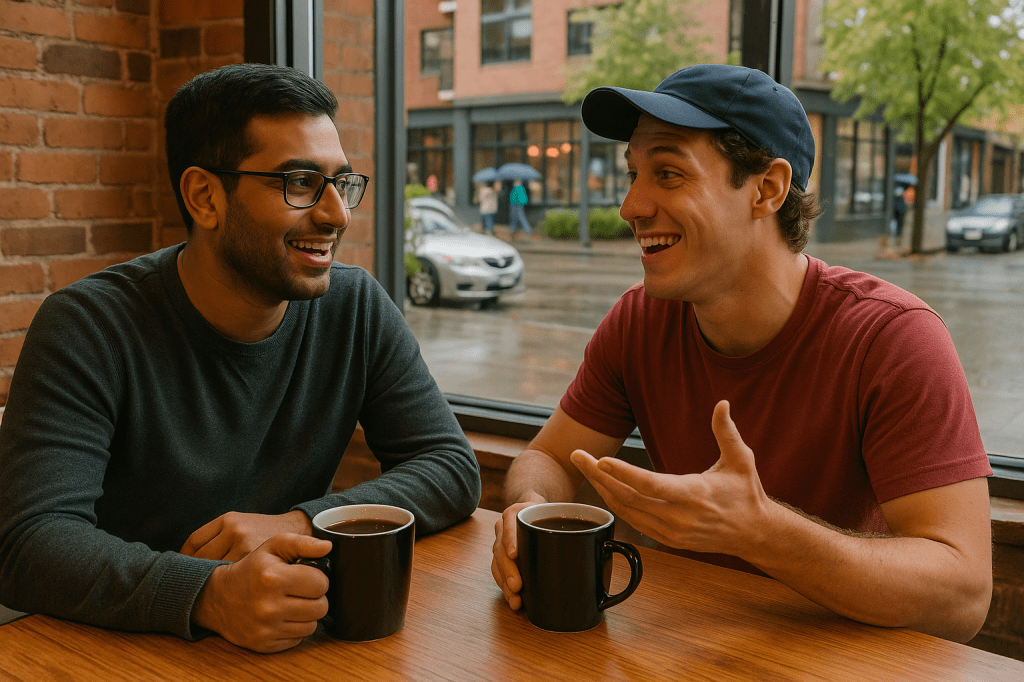
Scene: Saturday afternoon at a local café in Seattle, USA. Raj and Mikey are sipping coffee after a morning of bowling.
Mikey:
laughing Did you see that strike? I told you, man! First time I’ve ever bowled and boom—strike! Beginner’s luck is so real.
Raj:
Yeah, yeah, very impressive. But one strike doesn’t mean the universe handed you a golden ticket. It just means you got lucky—statistically speaking.
Mikey:
Raj, bro, I got three strikes in that game. Three! I’ve never touched a bowling ball in my life. And you—Mr. Physics PhD—scored less than me.
Raj:
Don’t remind me. My pride is still bruised. But that’s variance, not voodoo. You were just fresh, unpredictable. Not everything has to be mystical.
Mikey:
Unpredictable? Dude, that’s what the universe wants. It gives the newcomer a taste of glory, gets ‘em hooked. I’ve seen it at poker tables. First-timers win pots while seasoned players just groan and shake their heads.
Raj:
Sure, and they conveniently forget all the first-timers who lose their shirts. It’s a memory bias, Mikey. We remember the flashy stories, not the boring ones.
Mikey:
Okay, Mr. Bias Buster, explain my cousin Tanya. Never played roulette, walks into a casino, puts twenty bucks on red—wins three times in a row. She screams, does that TikTok dance, and cashes out $500 richer. How do you explain that?
Raj:
Simple. Roulette is a game of pure chance. There’s no skill, no beginner or expert. Someone has to win. Tanya just happened to hit a lucky streak. If she’d lost, you wouldn’t be telling the story.
Mikey:
But it happens all the time. Beginners just win! Even in Mario Kart, my niece trashed me on her first game. She didn’t even know what the drift button was!
Raj:
Okay, first, kids are terrifying in Mario Kart. Second, that’s just randomness—and maybe a bit of the “beginner effect.” Experienced players overthink, while beginners just go with the flow. That’s psychology, not magic.
Mikey:
So you’re saying there’s no cosmic force cheering for the underdog?
Raj:
Not unless the cosmos owns a sportsbook. Look, the “beginner’s luck” idea is appealing because it gives people hope. But from a scientific point of view, it’s just randomness plus selective memory.
Mikey:
Well, Mr. Science, what if the belief in beginner’s luck helps the beginner relax and play better?
Raj:
Now that I can buy. If you believe the odds are in your favor, you might stay calm, confident, and take better decisions—especially in games that require skill.
Mikey:
Boom! So you admit it has some truth.
Raj:
Psychological truth, yes. But it’s not the universe handing out starter packs like it’s an RPG.
Mikey:
Still, next time we go to Vegas, I’m bringing a friend who’s never played blackjack. I’ll ride that wave of luck straight to the buffet line.
Raj:
Fine. Just don’t drag me into any tarot readings afterward.
Mikey:
No promises. You could use a little “spiritual calibration.”
Raj:
And you could use a course in statistics. But hey, your coffee’s on me—call it “barista’s luck.”
[They both laugh. The debate settles, but the friendly clash of belief vs. reason continues—like all good friendships do.]
 Science Vs Superstition
Tell Us What You Think